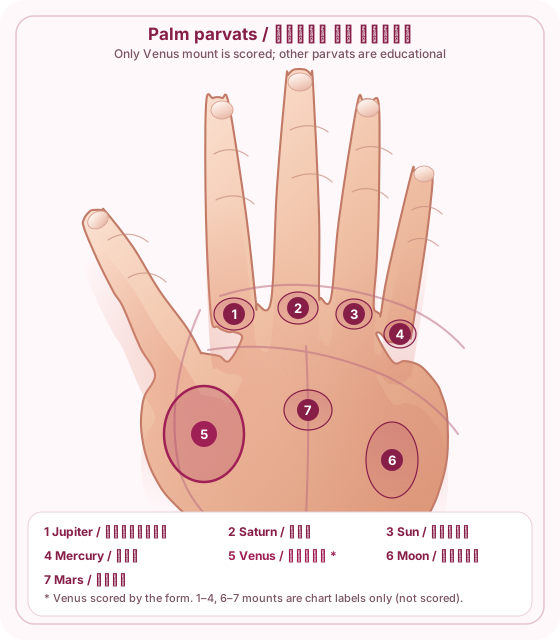
This is a hand-based tradition, not an astronomical one. No birth chart, no planetary longitude, and no ayanamsa is involved, and it would be dishonest to attach Lahiri calculations to a palm. The planetary names that appear in palmistry — the mounts of Jupiter, Saturn, Venus and so on — are symbolic labels for regions of the hand, not positions in the sky.
Read the result as reflective guidance. Palmistry cannot diagnose illness, predict a death, name a wedding date, or forecast income, and any reader who claims to do so is not practising the tradition honestly. Nothing here is medical, legal, or financial advice, and no line on your hand guarantees anything about your life.
The major lines and what they are called
Classical palmistry works with four principal lines. The heart line runs across the upper palm below the fingers and is associated with emotional style. The head line runs across the middle and is associated with thinking and decision-making. The life line curves around the base of the thumb, and the fate line, when present, runs vertically towards the middle finger.
The life line is the most misunderstood of the four. In traditional reading it is associated with vitality, physical constitution, and major changes of circumstance — not with lifespan. A short life line has never meant a short life in any careful text, and treating it that way causes real distress for no reason.
Minor lines include the sun or Apollo line, the marriage or relationship lines on the edge below the little finger, the health line, and the girdle of Venus. These are read as supporting detail. A feature that appears on one hand and not the other is treated as less settled than one that appears on both.
Mounts, hand shape, and why the whole hand matters
The mounts are the raised pads at the base of each finger and around the palm, named after planets: Jupiter under the index finger, Saturn under the middle, Apollo under the ring, Mercury under the little finger, with Venus at the thumb base and Luna opposite it. Their relative fullness is read as emphasis, not as a score.
Hand shape is the other broad layer. Traditional systems classify hands by the relationship between palm length and finger length, often mapped to the elements — earth, air, fire, and water. Finger flexibility, nail shape, and the set of the thumb are all read alongside.
A competent reading never rests on one feature. A long head line means something different on a firm square palm than on a soft tapering one, and a broken line with a clear overlap is read differently from a broken line with a gap. This is why a checklist of single lines produces such poor readings online.
Which hand to read, and how to photograph it
Indian tradition commonly reads the right hand for men and the left for women, while many modern readers use the dominant hand for the developed self and the non-dominant hand for inherited tendencies. This tool explains both conventions rather than pretending there is one settled rule.
For a usable image, photograph the open palm in bright, even daylight with the fingers relaxed and slightly apart. Avoid flash, which flattens the lines, and avoid a tight fist or a stretched hand, both of which distort the creases you are trying to read.
Take both hands if you can. Differences between them are informative in every school of palmistry, and a reader who only ever sees one hand is working with half the material. The tool will not invent details from a blurred image; it will ask for a clearer one.
Worked example: reading a head line properly
Suppose a hand shows a head line that starts joined to the life line, runs straight across, and ends below the ring finger with a small fork. The joined start is traditionally read as a cautious, family-influenced beginning; the straight run as practical thinking; the fork at the end as an ability to see two sides of a question.
Now add context. If the same hand has a full Mercury mount and long, flexible fingers, a reader would emphasise communication and adaptability. If instead the palm is square with short fingers and a firm Saturn mount, the same head line would be read as methodical and slow to change direction.
Neither reading predicts an event. Both describe a disposition in the language the tradition uses, which the person reading it can accept, reject, or find useful for reflection. That is the honest scope of a palm reading, and stretching it further is where palmistry turns into fortune-telling.
Honest limits and next steps
Palmistry has no demonstrated predictive mechanism, and the lines on a hand change slowly over a lifetime for ordinary physical reasons. It is a traditional interpretive art with cultural depth, and treating it as diagnosis or prophecy misrepresents both the tradition and the person being read.
Please never accept a health claim from a palm. If a reader tells you a line indicates disease, that is not medical information and acting on it instead of seeing a doctor can be genuinely harmful. Nothing here is medical, legal, or financial advice, and no honest reader will predict death or divorce from a crease.
If you want a system with calculated inputs, the astrology tools use your birth date, time, and place instead. A free kundli download, a full astrology reading, or the daily prediction pages all work from verifiable data rather than from an image of a hand.